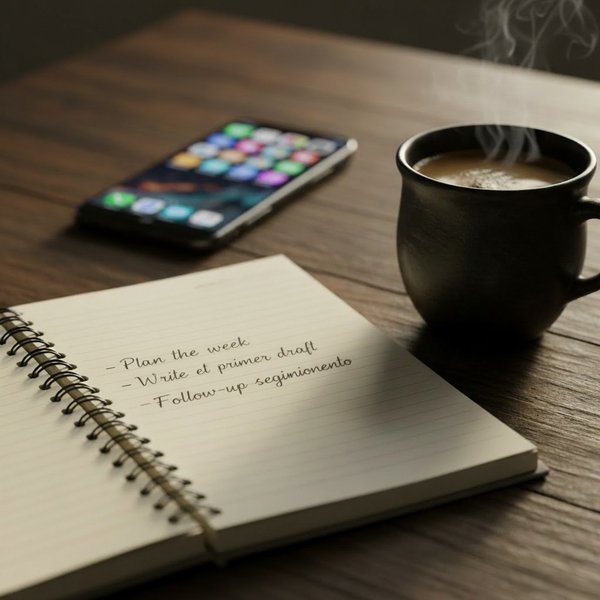
I was a productivity junkie. My phone was my command center, a glowing rectangle of pure potential. I had color-coded calendars, sophisticated to-do list apps that synced across all devices, and focus timers that gamified my workday. I was optimizing every second, convinced I was on the cutting edge of efficiency.
Yet, I felt more scattered and behind than ever. I was busy, but I wasn’t moving forward. The “productive” guilt of not using my tools correctly was a constant hum in the background.
The breakthrough came not from a new app, but from a catastrophe—my phone slipped from my hand and met its end on a concrete floor. For three days, I was untethered.
And it was the most productive I’d been in years.
The Lie of the All-in-One Device
We’ve been sold a dream: that the most powerful computer in your pocket is the ultimate key to getting things done. But this is a fundamental misunderstanding of both the tool and our own brains. Your smartphone isn’t a productivity tool; it’s a consumption tool that has been clumsily dressed up in productivity clothing.
Here’s the damage it’s silently doing to your focus and output.
It’s a Factory for Context-Switching
Every notification—even a vibration—is a cognitive “twitch.” Your brain has to disengage from your work, process the interruption, and then re-immerse itself. Research shows this “switch-cost effect” can make you up to 40% less productive and significantly more prone to errors. Your phone, by design, makes context-switching its default mode.
It Fractures Your Focus, Even When It’s Silent
A landmark study found that the mere presence of your smartphone, even face down and on silent, reduces your available cognitive capacity. Your brain is subconsciously always wondering, “What am I missing?” It’s a constant, low-level drain on your mental RAM, leaving less power for the deep work that actually matters.
It Steals Your Unconscious Processing Time
Those moments of “boredom”—waiting for coffee, standing in line, walking to your car—are not empty space. They are vital for your brain to make novel connections, solve complex problems, and process information. By reflexively filling every spare second with a scroll through social media or email, we rob ourselves of our most powerful creative insights.
The “Analog” Intervention That Changed Everything
Forced into a digital detox, I reached for the most ancient of technologies: a simple, A5 notebook and a good pen.
It felt like a step backward. It felt primitive. But within two days, the fog lifted. Planning my day on paper became a deliberate, thoughtful act. I couldn’t just drag and drop tasks mindlessly; I had to engage with them, which forced me to prioritize what was truly important. Taking meeting notes by hand meant I was synthesizing information in real-time, instead of being a stenographer trying to type every word. My to-do list became a peaceful, single-focused, non-judgmental space that could not interrupt me.
Your 3-Step Digital Detox for a More Focused Week
You don’t need to break your phone. Try this for just one workweek.
First, create a “Brain Dump” Sanctuary. Buy a notebook you love. Each morning, spend 5 minutes writing down everything you need to do. Then, circle the 1-3 things that constitute real impact, not just activity.
Second, banish the phone during deep work. During your most important 90-minute work block, put your phone in another room. Not on your desk. Not in your bag. Another room. The reduction in cognitive drain is immediate and palpable.
Finally, reclaim your “in-between” moments. The next time you’re waiting for something, fight the urge to pull out your phone. Just stand there. Look around. Let your mind wander. This is where creativity is born.
The goal isn’t to become a Luddite. It’s to use technology with intention. Your smartphone is a fantastic tool for communication and connection, but a terrible one for focused, deep work.
By giving your brain the gift of a single-tasking environment, you might just discover that the most advanced productivity system ever created doesn’t need a charger, an update, or a notification setting—it just needs a page and your attention.
Leave a Reply